Sagging Facial Skin: Understanding and Slowing Down the Process

Summary
Have you noticed that over time your face seems to lose firmness and sag slightly?
You're not alone, and many of us are looking for solutions. The bad news is that sagging facial skin is a natural and inevitable process.
Good news: It is completely controllable, and we can act on it effectively. 😁
In this article, we will explore the causes behind this process and discover solutions to regain firmer and more toned skin.
What is sagging facial skin?
Sagging facial skin corresponds to a progressive loss of firmness and elasticity of the skin.
This is what sometimes makes us want to pull our face in front of the mirror, hoping to regain that firm and smooth complexion of our younger years. 😅
In reality, sagging skin is simply a natural consequence of the passage of time. This is what we call skin aging . And yes, over the years, the structures that support the skin, such as collagen and elastin, become fragile. This deterioration leads to a loss of firmness, giving the skin a less toned, sometimes sagging, appearance.
The most affected areas are often the cheeks, jaw and neck.

Visible signs of sagging skin
Sagging skin can make your face look worn and tired, even after a good night's sleep! 💤💤
This loss of firmness accentuates the signs of aging and modifies the structure of the face.
Among the most visible signs, we find:
-
Appearance of jowls (sagging of the skin at the jawline, creating a “drooping cheeks” effect).
Loss of definition of facial contours.
Drooping eyelids.
Accentuation of existing wrinkles and fine lines.
On a psychological level, this change can give the impression of no longer recognizing one's face and can affect self-confidence.
Physiological causes of sagging facial skin
Sagging facial skin is due to internal age-related changes, and becomes particularly visible in mature skin .
These changes affect the very structure of the skin, as well as the elements that support it.
Several physiological factors are at the origin of this loss of firmness.
1/ Decrease in collagen and elastin
Collagen and elastin are essential proteins for skin firmness and elasticity. Collagen acts as a "framework" for the skin, while elastin allows skin tissue to regain its shape after stretching.
From the age of 30, collagen production decreases by about 1% per year, while elastin, already less present, also degrades. This decline reduces the skin's resistance, which becomes less able to maintain its structure.
Result: the skin sags, especially on the cheeks, jaw and neck.
2/ Loss of subcutaneous fat
Subcutaneous fat is a layer of fatty tissue located just below the skin. It plays a vital role in maintaining the youthful, plump appearance of the face by acting as a natural cushion that supports the skin and cushions muscles and bones.
With age, this fat decreases, especially around the cheeks, temples and under the eyes, creating a sunken effect (and here come the hollow dark circles).😒
This loss of volume, combined with the decrease in collagen, alters the contours of the face, making it more angular and accentuating the signs of aging.
3/ Weakening of facial muscles
The muscles of the face, like those of the body (sorry to remind you), lose tone and strength over time. They play an essential role in maintaining the firmness of the skin. As we age, this loss of tone leads to sagging of the features, accentuating the sagging of the skin of the face .
Without good muscle tone, the skin is less supported, which results in a loss of contour definition, particularly in the jaw and cheeks.

4/ Reduction in bone density
Facial bones, particularly those in the cheeks, chin, and jaw, undergo progressive bone resorption, reducing their volume. This process of bone loss compromises the structure that supports the skin, leading to more pronounced sagging.
This has a direct effect on the contours of the face and unfortunately makes the skin more flaccid.
5/ External factors accelerating relaxation
Our lifestyle and environment also play an important role in sagging facial skin . Some of the factors responsible include:
Prolonged UV exposure : UV rays destroy collagen and elastin in the skin, causing wrinkles and sagging.
Oxidative stress : Free radicals (unstable molecules that damage cells), resulting from pollution, smoking and UV rays, among other things, accelerate aging and sagging.
Tips to slow down sagging facial skin
Although skin aging and loss of elasticity are inevitable, it is entirely possible to slow down this process and reduce the visible signs of aging.
Topical anti-aging care
One of the first steps to slowing sagging facial skin is the regular use of appropriate topical skincare. Choose creams and serums containing retinol, peptides, vitamin C, and antioxidants. These ingredients stimulate the production of collagen and elastin, helping to restore skin firmness.
Additionally, don't hesitate to use serums or products based on hyaluronic acid (well known for its use in injections) to plump the skin.
Let's not forget that its level naturally decreases with age , which contributes to the loss of firmness and the appearance of wrinkles.

Daily sun protection
As we have seen, exposure to UV rays is one of the causes of premature skin aging.
To prevent the breakdown of collagen and elastin, don't skimp on sunscreen, even in winter! 🌞
Facial massage techniques
Very popular, facial massage tutorials are popping up everywhere, and for good reason: they stimulate blood circulation and strengthen facial muscles, thus improving skin firmness.
The effect is often immediate: you feel like you've redefined your facial features, smoothed out fine lines under your eyes, and revived your complexion. A real little natural facelift! 👌🏼
You can use tools like jade rollers or gua sha to maximize the effects. In addition to toning the skin, these techniques reduce muscle tension, leaving a more relaxed and toned face.
Food and food supplements
Taking care of yourself from the inside out is reflected on the outside.
➡️ Choose foods rich in vitamins C and E, powerful antioxidants, as well as omega-3, which support collagen production and keep skin in good condition.
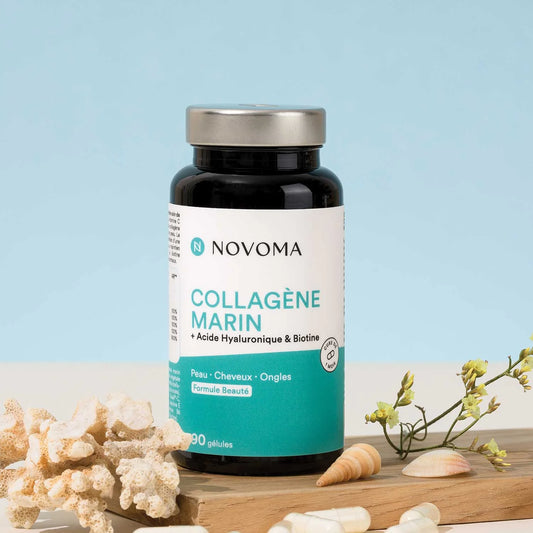
➡️ Dietary supplements also play a key role when internal support is needed. Marine collagen strengthens the skin's structure by replenishing the natural decline in production, while coenzyme Q10, a powerful antioxidant, protects cells and stimulates skin regeneration. Together, they maintain firmness and elasticity, slowing down the visible signs of aging .
Facial Toning Exercises
It's time for facial gymnastics! 🤸🏼♀
Did you know that facial exercises can strengthen the underlying muscles of the face? Some of them even target specific areas to improve tone. Here's a tutorial:
Smiling fish face : Suck your cheeks inward, forming a "fish" mouth while maintaining a slight smile. Hold for 5 to 10 seconds, then release. Repeat 10 times to strengthen the muscles in your cheeks and around your lips.
Cheek lift : Smile broadly, then place your fingers slightly above your cheekbones. Lift your cheeks toward your eyes while gently closing your eyes. Hold this position for 10 seconds, release, and repeat 5 times. This exercise helps tone your cheeks and combat sagging.

Professional treatments
If you're looking for more advanced solutions, there are several non-invasive aesthetic treatments that can combat sagging facial skin :
Filler injections: restore lost volume in the cheeks and furrows to smooth the face.
Radiofrequency: This technique uses radio waves to heat the skin and stimulate collagen production at superficial levels, gradually improving firmness.
Focused ultrasound: like radiofrequency, this is a non-invasive technique, without injection, but which acts more deeply.
Conclusion
In summary, sagging facial skin is a reality, but certainly not inevitable!
With the right actions, suitable care, and a well-thought-out routine, you can take action to maintain firm and toned skin for longer. 😉