Shilajit dangers: what are the risks to know before using it?

Summary
Shilajit, a mysterious black resin extracted from the mountains, is as intriguing as it is fascinating. Presented as an elixir of vitality and longevity, should we be wary of the dangers of shilajit ? Behind its image as a natural ally with a thousand virtues, shilajit also hides some gray areas.
Between its actual properties, its traditions of use, and the potential risks linked to its quality or consumption, shilajit deserves to be examined with discernment. Because if nature does things well, industry can also muddy the waters! ☝️
In this article, find out everything you need to know about the dangers of shilajit, its benefits, and how to use it safely.
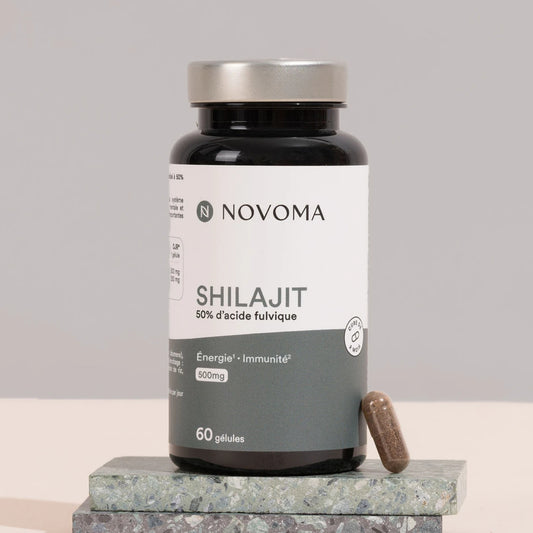
What is shilajit or vitality resin?
Before we talk about the dangers of shilajit , a brief introduction to this mysterious substance is in order! And you might be one of those who doesn't know anything about this trendy resin.
A natural substance from the mountains and Ayurvedic traditions
Shilajit is not a recent marketing invention, but finds its origins in the ancestral traditions of Asian countries, but not only! This resinous substance comes from the decomposition of plant and microbial matter trapped for centuries in the rocks of high mountains, mainly the Himalayas, but also Altai, Tibet and the Caucasus.
Under pressure, time and heat, this organic matter transforms into a black, viscous and shiny resin that the inhabitants of these regions have known for millennia.
🏔️In some areas, shilajit is even nicknamed "oil of the mountains", "blood of the rocks" or "black gold", so unique is its appearance. This slow process explains why shilajit is rare and precious, but also why its quality can vary greatly depending on the extraction location!
A composition rich in minerals, fulvic acids and antioxidants
Shilajit is so intriguing because it contains essential elements. It contains around fifty minerals in ionic form that are easily assimilated by the body. It contains iron , zinc , magnesium , but also copper and selenium !
But it is its richness in fulvic acids that turns out to be one of its main assets: these molecules facilitate the absorption of nutrients and act as powerful antioxidants . These compounds help fight against oxidative stress, this famous process which contributes to cellular aging.
🧬Shilajit also contains dibenzo-α-pyrones , a family of bioactive compounds known to protect mitochondria, the powerhouses of our cells.
A long tradition: the history of its use in Ayurvedic medicine
Traditionally, shilajit holds a very special place in Ayurveda where it is considered a “ rasayana ,” that is, a regenerative substance that maintains vitality, strength, and longevity.
📖 Ancient texts even mention it as a natural aid used to boost energy, support memory, immunity, libido (including testosterone levels and sperm quality), reduce oxidative stress, and promote overall balance.
Today, some claims are still mentioned by practitioners, but it is important to remember that only properties validated by health authorities are officially recognized. The rest belongs more to the realm of tradition than modern science, although numerous studies reveal the potential of this mysterious resin!

What are the benefits of shilajit according to science?
Shilajit, also known as the “black gold of the Himalayas,” is traditionally used as a tonic. However, it is said to have many other benefits due to its richness in minerals and fulvic acid.
Boost energy and vitality
🪫Shilajit is said to act on ATP production, supporting endurance and helping to combat fatigue. One study reports that it is also an asset in physical recovery, maintaining muscle strength , and bone strength .
Support cognitive functions
Some studies highlight its positive effect on mental clarity, memory, and concentration thanks to the presence of antioxidants. Another study conducted in Iran on the effects of shilajit on the brain highlighted the positive impact it could have on reducing cerebral edema in cases of head trauma. This proves to be a serious avenue for improving the neurological outcomes of those affected!
Contribute to hormonal and sexual balance
In men, consuming shilajit helps increase testosterone levels and support fertility . While in women, it helps support urogenital functions, energy balance, and overall tone!
Protect cells from oxidative stress
Thanks to its antioxidant properties, shilajit may support tissue repair and even combat minor ailments. A study published in 2020 highlights that consuming shilajit may even have positive effects on skin tone and elasticity, due to its influence on blood vessel growth.
Support the immune system and detoxify the body
By acting as a natural adaptogen, shilajit helps the body better respond to unwanted agents. It supports the immune response and fights against stressors. But it's the presence of fulvic acid that interests us regarding its effect on the elimination of heavy metals and toxins accumulated in the body. In short, a real ally if you decide to do a detox !
What are the effects of fulvic acid, a key component of shilajit?
Fulvic acid is a natural compound found in soil, sediment, and certain substances such as shilajit. Fulvic acid acts as a nutrient transporter in the body and exhibits antioxidant effects, protecting cells from oxidative stress and aiding in tissue regeneration. Some studies also report that fulvic acid may be beneficial in managing blood sugar and preventing chronic conditions.
Fulvic acid also promotes energy production and facilitates the body's detoxification processes . It is therefore this compound that seems to provide shilajit with its energizing, detoxifying and antioxidant properties, hence the importance of selecting it carefully in order to reap all the benefits! 💪

Shilajit dangers: what are the possible risks?
Before we see it as a miracle cure, let's take a look at the other side of the coin: shilajit can present dangers and associated risks , especially if its quality leaves something to be desired. On this side, shilajit presents two types of risks: those linked to the possible presence of contaminants, the other linked to its composition.
Risk of contamination by heavy metals and impurities
This is probably the main danger of shilajit . As a product of rocks and soil, shilajit can concentrate natural impurities as well as modern pollutants. Mining areas, sometimes located in poorly controlled regions, can expose the product to contamination by high levels of lead, arsenic, or mercury.
⚠️Add to that some unscrupulous processing methods, and you get a potentially harmful product! Which would be a shame, given that its main component, fulvic acid, is specifically designed to support the body's detoxification.
And we know that, in the long term, the accumulation of heavy metals can affect the liver, kidneys, and nervous system, and even cause more chronic conditions. This is why it is essential to only buy purified shilajit, tested and certified by independent laboratories. Because the "natural" label can hide a less than clean reality!
Excess minerals or possible interactions
Another, more subtle risk lies in its mineral richness. Due to the presence of minerals, the danger of taking shilajit can come from the overload and accumulation of certain minerals in the body, already provided by food or dietary supplements.
For example, excess iron can cause iron overload with serious consequences for the liver and heart. Excess zinc can disrupt copper absorption and lead to imbalances.
⛔Finally, shilajit could interact with certain treatments : for example, anticoagulants or protocols intended to regulate blood pressure. Here again, it's all a question of dosage and individual adaptation.
As you can see, just because a substance is natural doesn't mean it's harmless. Plants and minerals can be powerful allies, but as with everything, it's the dose that makes the poison!
What are the potential side effects of consuming shilajit?
Even a purified product may not be suitable for everyone, and the body sometimes has its own reactions. In rare cases, shilajit can cause adverse effects.
👉Mild digestive problems: some users report mild digestive problems: bloating, abdominal discomfort, or even temporary diarrhea.
👉Skin reactions: In rare cases, reactions such as rashes or itching of the skin have been observed. Nothing dramatic, but enough to remind you of a simple rule: if your body sends you an unusual signal after taking shilajit, it is best to stop immediately and consult a healthcare professional. And in this regard, we know that vigilance remains the best reflex!
Of course, stop taking the product if you experience any unusual reactions, discomfort, or signs of discomfort while you check the source of your discomfort. As always, caution is advised!
What precautions should be taken before using shilajit?
Before giving in to temptation, there are a few precautions worth taking to prevent any dangers associated with shilajit .
Special situations that require advice from a healthcare professional
As with other natural substances, certain periods of life or specific situations require seeking the advice of a health professional before using shilajit:
➡️ Pregnancy, breastfeeding, chronic conditions (especially liver, heart, or kidney disease). People already taking medication should also seek advice from their doctor to avoid any interactions.
Respect the recommended dosages
Shilajit is typically consumed in very small amounts, on the order of a few hundred milligrams per day. Exceeding these doses serves no purpose, except to take unnecessary risks!
But what is the recommended dose of shilajit? In reality, it all depends on its form (resin, powder or capsule) and its purity:
Purified resin : usually 300 to 500 mg daily, dissolved in warm water, milk, or under the tongue.
-
In standardized powder or capsule form: generally 250 to 500 mg per day, depending on the fulvic acid concentration.
👉 If in doubt, you can start your treatment with a small dose (≈100–200 mg/day) to test your digestive tolerance, then gradually increase if you do not observe any adverse effects. Take periodic breaks (a few days a week or every 4–6 weeks) to avoid potential digestive irritations.
💡 Last piece of advice (and this applies to other supplements, so listen carefully) : a common mistake is to believe that increasing the dose will accelerate the benefits. In reality, it mainly increases the likelihood of side effects. 🙄
Check the origin and certifications
As with any supplement, the best protection remains transparency!
✅ A quality shilajit should be purified, free of contaminants, and accompanied by certified analyses. Avoid products without precise labeling or with overly vague promises. A good supplier should clearly state the origin, the purification processes carried out, the composition, and the controls performed.

How to avoid the dangers of shilajit?
A few good practices are enough to considerably reduce the dangers of shilajit , here is our advice.
Choose a purified and laboratory-tested product
✅ Raw, unpurified shilajit is not recommended! Commercial versions must have undergone a rigorous purification process and be accompanied by laboratory analyses proving the absence of heavy metals and contaminants, thus guaranteeing the quality of the product.
Favor a transparent brand
✅ A serious brand communicates on the origin, the purification methods, the labels and the certifications obtained . And it does not hesitate to provide the analysis reports!
Conversely, if the information is unclear, it's best to move on! Regarding the origin, choose brands offering shilajit from the Himalayas or renowned mountainous regions.
Read labels and instructions carefully
Never underestimate the importance of the small print. Check the dosage, recommendations, and contraindications listed, not forgetting any certificates of origin and labels. While this may seem tedious, it's the best guarantee of safety!
✅ Composition-wise, it should display the fulvic acid and mineral content, and the color should be uniform, dark brown to black.
Shilajit fascinates with its history and promises. But like any powerful substance, it requires a dose of vigilance. Behind the "natural substance" trend, risks exist, especially if the quality isn't up to scratch. The solution? Get informed, choose certified products, and listen to your body. And what do you think of mountain resin?