Omega 3-rich oil: which one to choose and why consume it?

Summary
In your kitchen, olive oil reigns supreme. Right behind it, sunflower oil is a favorite... and somewhere at the back of the cupboard, there's a little space for rapeseed oil. Why this one? Because you've vaguely heard that it's rich in omega-3 .
But that's not all... Linseed oil, camelina oil, cod liver oil, or even algae oil: how do you choose the right oil rich in omega 3 , according to your needs, age, or lifestyle? We'll help you sort through them—and, above all, make the right choice. 😉
Why are omega 3s essential for the body?
Omega-3s are a family of healthy fats found in certain oils, oily fish, and seeds. Unlike saturated fats (which we often consume in excess), they have a positive effect on the body's balance. There are several types, each with a specific role.
The three main types of omega 3
So, who does what in this sibling group? Let us introduce them to you:
ALA (alpha-linolenic acid): this is the omega 3 found in vegetable oils (flax, camelina, chia, etc.) and nuts like walnuts.
ALA is the precursor to the active forms EPA and DHA. The problem? The body processes very little ALA (less than 10%), hence the importance of also consuming marine-sourced omega-3s (we'll come back to this point a little later in our article).-
EPA (eicosapentaenoic acid): present in oily fish (herring, trout, salmon, tuna, mackerel, etc.) and the oils extracted from them. EPA is directly usable by the body.
DHA (docosahexaenoic acid): another omega 3 of marine origin, DHA also exists in a plant-based version, extracted from algae.
We recommend you

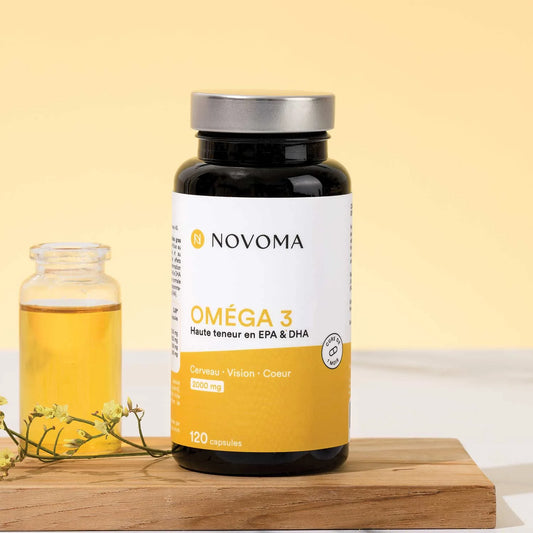
Omega 3
Ultra-pure fish oil concentrated in essential omega-3 fatty acids (90% triglycerides).
- ✅ Ultra Pure EPAX® Fish Oil
- ✅ 800 mg EPA & 600 mg DHA
- ✅ Friend of the Sea®
- ✅ Minimal oxidation (Totox < 3)
A key role in the body's balance
Omega-3s are essential fatty acids: our bodies don't produce them, but they need them to function properly. But how exactly do they support our bodies?
Docosahexaenoic acid (DHA) contributes to normal brain function. 🧠 It also helps maintain normal vision.
EPA and DHA support normal heart function and contribute to the maintenance of balanced blood pressure.
ALA (alpha-linolenic acid) , for its part, contributes to the maintenance of normal cholesterol levels.
➡️ To go further: Discover all the benefits of omega 3 in our dedicated article.
Daily omega 3 requirements according to age and profiles
Our omega-3 needs change throughout our lives. Here's a quick recap to help you better understand the recommended intake for each individual.
In infants (0 to 1 year) : approximately 500 mg per day, mainly provided by breast milk or fortified infant formula.
In children and adolescents: between 700 mg and 1 g per day, to support growth and brain development
In adults : Men need about 1.6g of omega-3 per day, compared to 1.1g for women, to contribute to the proper functioning of the heart and brain.
-
For pregnant or breastfeeding women : recommended intake increases to 2g per day to support the development of the baby's brain.
For seniors : needs increase slightly. Between 1.5 and 2 g of omega-3 per day are recommended to maintain cognitive and cardiovascular functions.
💡 These contributions can be covered by combining a varied diet, including in particular an oil rich in omega 3 , oily fish and, if necessary, appropriate supplementation.

Vegetable oils rich in omega 3
While some oils are perfect for cooking or frying, others are real allies for enriching your diet with omega 3. Here is a quick overview of the main oils rich in omega 3 , to favor in your dishes (especially cold!).
Linseed oil
It's THE champion of vegetable oils when it comes to omega 3, with a concentration that can exceed 50% ALA. But be careful, this oil, rich in omega 3, is also one of the most fragile: it goes rancid quickly, doesn't withstand cooking, and must be kept in the refrigerator (otherwise it's oxidized, and our cells don't like that at all).
Use only cold, in a salad or a bowl of steamed vegetables.
Rapeseed oil
Less fragile and easier to use on a daily basis, it is the most widely used oil in France after olive oil. It is naturally rich in omega 3 (around 9% ALA ), also contains vitamin E, and has a neutral taste that goes well with everything. Ideal as a seasoning, it can also be heated gently without too much risk. A truly good nutritional and practical compromise.
Walnut oil
With its pretty amber color and strong flavor, it appeals to lovers of rustic flavors. It is interesting for its richness in magnesium, vitamin E... and of course, omega 3. Two tablespoons are enough to cover the recommended daily intake. Very fragile, it does not withstand cooking and must be well stored away from light and heat.
Camelina oil
Often overlooked, it is nevertheless worth knowing: its fatty acid profile is close to that of linseed oil, but it is a little more stable. Its grassy taste is pleasing (or not), but nutritionally speaking, it is a real oil rich in omega 3 , with a good omega 3/6 ratio.
Chia oil
Still not very common in our cupboards, but ultra-rich in ALA, it can contain up to 60% omega 3! Its taste is neutral, and it's a good choice for varying pleasures.
We see you coming: yes, chia seeds are also rich in omega 3. 😉
But they need to be crushed to be properly assimilated.
➡️ To avoid enriching your diet with omega 3: sunflower oil or grape seed oil, because they are low in omega 3 and often too rich in omega 6 or saturated fatty acids.
By the way, on this subject: what is the real difference between omega 3 and omega 6? We explain everything in our dedicated article .

Marine oils rich in omega 3
While vegetable oils primarily provide ALA, marine oils rich in omega-3 have the advantage of directly providing EPA and DHA, the two most active and bioavailable forms. They are found in oily fish and some marine-based alternatives.
Cod liver oil
This is probably the best known! It contains both EPA, DHA, and vitamins A and D. Nutritionally very complete, it should be consumed in moderation, as its high vitamin A content can become toxic if taken in excess.
Fish oils (sardine, mackerel, anchovies, etc.)
They are among the most effective sources for meeting EPA and DHA needs. In liquid or capsule form, they are easy to integrate into your daily routine. 🐟
Krill oil
Extracted from a small Antarctic crustacean, it stands out for its very good assimilation: the omega 3 it contains is bound to phospholipids, which makes it more easily absorbed by the body. It also contains astaxanthin , a natural antioxidant that helps protect it from oxidation.
Algae oil
This is the ideal plant-based alternative for people who don't eat fish. Rich in DHA (and sometimes EPA depending on the formula), it is obtained from microalgae grown in a controlled environment. An excellent choice for vegetarians or vegans, to limit the risk of deficiencies associated with this type of diet.
We recommend you
Omega 3
Ultra-pure fish oil concentrated in essential omega-3 fatty acids (90% triglycerides).
- ✅ Ultra Pure EPAX® Fish Oil
- ✅ 800 mg EPA & 600 mg DHA
- ✅ Friend of the Sea®
- ✅ Minimal oxidation (Totox < 3)
How to integrate these omega 3-rich oils into your diet?
We want to reassure you right away: no one here will be forced to drink cod liver oil every morning to get their omega 3 intake. 😂
There's no need to completely change your diet to benefit from the benefits of oils rich in omega 3. You just need to add them gradually, taking into account their fragility when cooked (that's really a crucial point!).
Cold: seasoning, the best option
Most vegetable oils rich in omega-3, such as flaxseed, camelina, or walnut oil , are very sensitive to heat. To avoid oxidation, they should only be consumed cold: in a vinaigrette, on steamed vegetables, or to enrich a warm soup just before serving.
A little tip: varying your oils throughout the week allows you to benefit from a good balance of fatty acids while taking advantage of their nutritional specificities (don't shy away from your good old olive oil!)
Slow cooking: some possible options
Rapeseed oil is more heat-stable than other omega-3-rich oils, so it can be used for gentle cooking over moderate heat. That said, it's best eaten raw to preserve as many of its nutrients as possible.
Another option: chia oil . Less well-known, it has a high smoke point, around 210–215°C, which means it can theoretically be heated without degrading. And since you asked, the smoke point is the temperature at which an oil begins to smoke and produce potentially harmful compounds.
By consuming oily fish
Supplementing your diet with two portions of oily fish per week (mackerel, sardines, salmon, etc.) increases your intake of EPA and DHA, the directly active forms of omega 3. Yum, delicious salmon en papillote or grilled sardines in the summer! ♨️
Why consider omega 3 supplementation?
Even if you have stocked up on good oils rich in omega 3 , it is not always easy to cover all of your daily needs, particularly in EPA and DHA.
When food is not enough
Unless you're a big fan of canned tuna or mackerel, you rarely get enough oily fish. Whether it's due to taste, vegetarian preference, or simply habit, it's common to not eat it twice a week, as we recommended above.
Omega 3 supplementation then becomes an interesting solution to cover your needs.
ALA in vegetable oils is not enough
Vegetable oils mainly provide ALA, but its conversion into EPA and DHA by the body remains very limited (remember: often less than 10%).
Why? Because this process involves several enzymatic steps, which are not very efficient in adults. Conversion can be further reduced in cases of stress, deficiencies (zinc, vitamin B6), or an excess of omega-6 in the diet. As a result, only a small fraction of the ALA consumed is converted into truly active forms.
Bottom line: you can drown your raw vegetables in walnut oil every day… it won’t do miracles in terms of EPA and DHA. 😂
Some profiles have increased needs
Some profiles have increased needs in omega 3, this is the case for example:
-
Pregnant or breastfeeding women , for the development of the baby's brain
Seniors , for the maintenance of cognitive and cardiovascular functions
Athletes , who use their muscles and joints more intensively.
The right choice: Novoma omega 3
If you are looking for a reliable, concentrated and perfectly assimilated source, look no further: our omega 3 meets all the required criteria.
Formulated with wild fish oils , our capsules are highly dosed in EPA and DHA, with no unpleasant aftertaste, no unnecessary additives and easy to integrate daily.
What makes all the difference is the Epax® certification . This international label guarantees:
Optimal purity (zero heavy metals, PCBs or other contaminants),
Optimal bioavailability for the body
-
Increased stability (fatty acids are protected from oxidation),
Complete traceability, from sustainable fishing to encapsulation.
In short: an ultra-high-quality supplement, for those who want real effectiveness... with complete confidence.
Vegetarian friends, don't forget that there are plant-based alternatives, made from microalgae. 👌🏼
To conclude
Finding the right omega-3 oil isn't that complicated—especially when you know what you're looking for. With a few tweaks (or a good supplement), you can easily cover your omega-3 needs and reap the benefits. So, flax, rapeseed, krill, or capsules? The choice is yours 😉