







What is collagen?
Collagen is the most abundant protein in the human body. It forms the framework of connective tissues: skin, bones, tendons, ligaments, and cartilage owe their cohesion and flexibility to it.
The body produces it naturally, but this production gradually slows down starting from age 25, and this phenomenon accelerates with age.
In its native form, collagen is arranged in a triple helix: three chains of amino acids wrapped around one another. This architecture gives it its mechanical strength, but also a high molecular weight that makes it difficult to absorb orally.
Enzymatic hydrolysis fragments this structure into shorter collagen peptides that can be directly absorbed in the intestines: this hydrolyzed collagen is what you find in food supplements (1).
There are around thirty types. Three account for most nutritional applications: types I, II, and III, each playing a distinct role depending on the tissue.
What are the benefits of collagen?
The benefits of collagen focus on three areas:
Skin. With age, the dermis loses density, firmness and hydration decrease, and wrinkles appear. An intake of collagen peptides promotes skin hydration and firmness and helps smooth the appearance of wrinkles.
Joints. Collagen is a component of connective tissues and cartilage two structures subjected to stress during daily movements and physical effort alike. Regular collagen intake contributes to joint well-being and supports flexibility and mobility.
Sports and recovery. Tendons and ligaments bear most of the mechanical stress during exertion. Collagen helps post-workout recovery, especially when resuming physical activity.
These benefits build up over time. A collagen supplement should be evaluated over several weeks, never over just a few days.
What are the different Novoma collagens?
Each of the four food supplements in our collagen range meets a specific need.
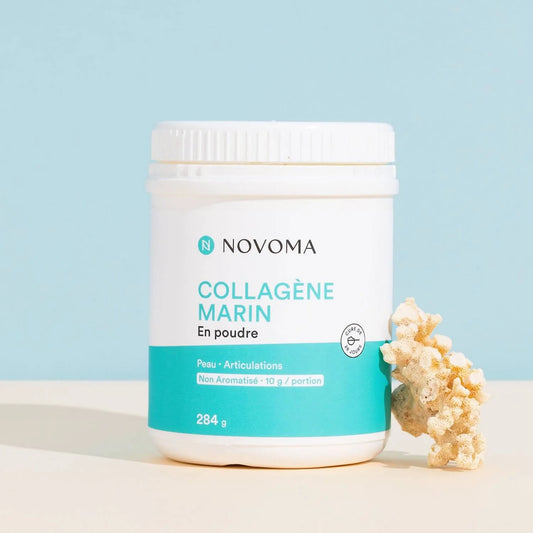
Marine Collagen Powder: the highest daily dose
The highest-dosed and purest formula in the range: 10 g of Naticol® hydrolyzed marine collagen, types I and III, combined with 150 mg of vitamin C. No other active ingredients, available unflavored or in three delicious flavors. It is suitable for anyone looking to maintain their intake over the long term, for both skin and joints.
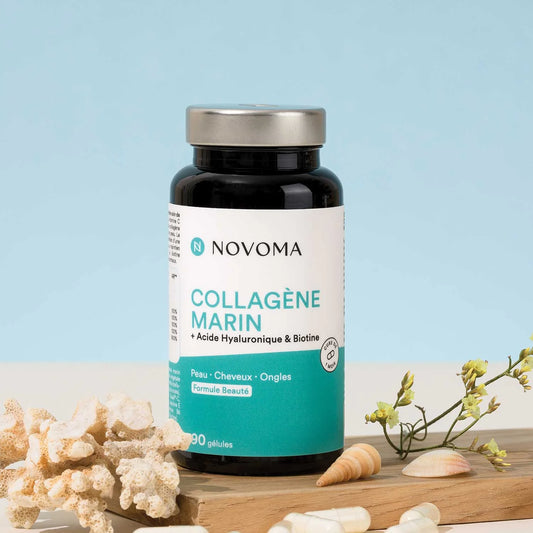
Marine Collagen Capsules: the on-the-go beauty formula
1,000 mg of Naticol® combined with hyaluronic acid, vitamins C, E, and B6, zinc, and biotin seven active ingredients for skin, hair, and nails. Three capsules per day in a bottle that easily fits in your bag: the ideal format if you travel frequently.
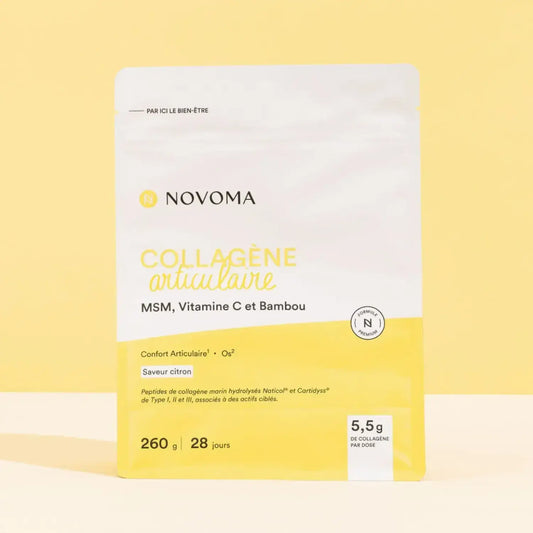
Joint Collagen: three types of collagen and MSM
The only formula in the range to combine Naticol® (types I and III) with Cartidyss® (type II), the form naturally found in cartilage. Enhanced with 3 g of OptiMSM® MSM, 100 mg of bamboo extract including 75 mg of silica, and 150 mg of vitamin C. A formula designed for the mobility and recovery of your joints, available in Lemon and Coconut flavors.
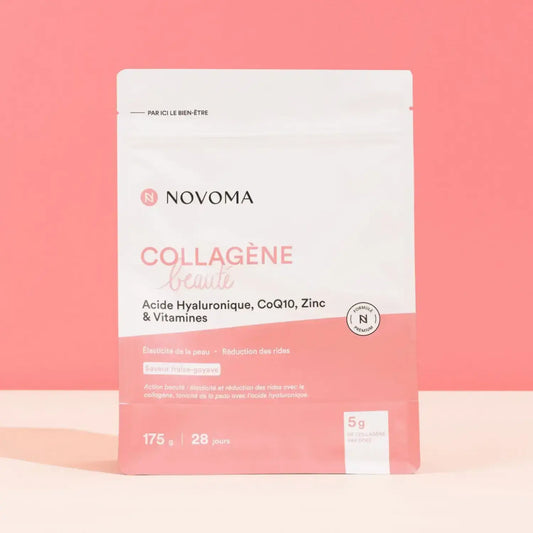
Beauty Collagen: the most comprehensive formula for the skin
5 g of Naticol® reinforced by three patented ingredients: ExceptionHYAL® Star hyaluronic acid, CAVAQ10® coenzyme Q10, and TRAACS® zinc bisglycinate, complemented by vitamin C and biotin. A formula crafted for hydration, firmness, and the appearance of wrinkles, available in Strawberry-Guava and Vanilla-Pecan flavors.
How to choose the right collagen?
To choose your collagen wisely, four questions should be considered: its origin, its form, its type, and its format.
Marine or bovine: how the origin matters
Marine collagen comes from fish skins and scales, while bovine collagen comes from cow hides and bones. Marine collagen stands out due to a different peptide profile, high protein yield, and a lower environmental footprint, as it upcycles fishing by-products. For these reasons, we chose it across our entire product range.
Hydrolyzed or native: a matter of absorption
Native collagen is a massive molecule, around 300,000 daltons, which is poorly absorbed by the intestine. Enzymatic hydrolysis breaks down its long chains into collagen peptides also known as hydrolyzed collagen with a much lower molecular weight. Naticol®, for instance, drops to 2,000 daltons, making it highly bioavailable to the body.
Types I, II, and III: what do they correspond to?
Type I dominates in skin, bones, and tendons; type II makes up cartilage; type III accompanies type I in soft tissues and blood vessels. A nuance worth noting: after hydrolysis, this distinction loses much of its relevance, as peptides are absorbed globally. Joint Collagen remains the only product in our range to incorporate type II.
Powder or capsules: a question of dosage
Powder allows for high dosages, from 5 to 10 g per serving, which capsules cannot hold. Capsules provide less collagen but offer additional complementary active ingredients, and are easier to carry around. Your choice depends on your goal: maximum dosage or a comprehensive formula.
Which active ingredients should be paired with collagen?
Four active ingredients enhance the action of collagen, which is why we incorporated them into our formulas.
Collagen and vitamin C
Vitamin C contributes to normal collagen formation for the normal function of skin, cartilage, and bones. All four of our formulas contain it, but the combination is most straightforward in Marine Collagen Powder: Naticol® and vitamin C, nothing else.
Collagen and hyaluronic acid
These two components of the extracellular matrix have distinct roles: collagen provides structure, while hyaluronic acid retains water and promotes skin hydration (2). Marine Collagen Capsules combine both, providing 100 mg of hyaluronic acid per dose.
Collagen and MSM
MSM, or methylsulfonylmethane, is a source of organic sulfur a mineral present in cartilage, tendons, and ligaments. Joint Collagen provides 3 g per dose in the patented OptiMSM® form (3).
Collagen and zinc
Zinc contributes to the maintenance of normal skin, normal nails, and normal hair. Beauty Collagen delivers 10 mg per dose using patented TRAACS® bisglycinate, selected for its bioavailability.
Scientific references
1. Sibilla S, Godfrey M, Brewer S, Budh-Raja A, Genovese L (2015). An Overview of the Beneficial Effects of Hydrolysed Collagen as a Nutraceutical on Skin Properties: Scientific Background and Clinical Studies. The Open Nutraceuticals Journal, 8:29-42. Literature review. https://doi.org/10.2174/1876396001508010029
2. Michelotti A, Cestone E, De Ponti I, Pisati M, Sparta E, Tursi F (2021). Oral intake of a new full-spectrum hyaluronan improves skin profilometry and ageing: a randomized, double-blind, placebo-controlled clinical trial. European Journal of Dermatology, 31(6):798-805. Tested ingredient: ExceptionHYAL® Star hyaluronic acid, 200 mg per day for 28 days. https://doi.org/10.1684/ejd.2021.4176
3. Toguchi A, Noguchi N, Kanno T, Yamada A (2023). Methylsulfonylmethane Improves Knee Quality of Life in Participants with Mild Knee Pain: A Randomized, Double-Blind, Placebo-Controlled Trial. Nutrients, 15(13):2995. Tested ingredient: methylsulfonylmethane (MSM), 2 g per day for 12 weeks. https://doi.org/10.3390/nu15132995
The information on this page is provided for informational purposes only and does not replace medical advice. In case of illness, ongoing medical treatment, or pregnancy, seek advice from a healthcare professional before starting any supplementation. Food supplements are not a substitute for a varied and balanced diet or a healthy lifestyle. Do not exceed the recommended daily dose.
Your questions about Collagen
Is it good to take collagen every day?
How long does a collagen treatment last?
Does collagen taste like fish?
Is collagen safe during pregnancy?
Should you wait until a certain age to take collagen?
Can collagen be combined with other supplements?
Les articles les plus lus


Si vous ne trouvez pas les informations que vous cherchez, n’hésitez pas à consulter notre FAQ ou à nous écrire sur le chat 24/24. Vous pouvez aussi nous contacter :


